

Raise is the world's largest gift card exchange, connecting millions of buyers and sellers across more than 1,000 global brands. Over the past decade, Raise has successfully processed more than $10 billion in transactions for its 6 million users. Originally founded in the US, the company has since expanded internationally into the UK and Canada.
Raise was handling billions in transactions when they noticed a growing problem. Fraudsters were increasingly targeting their platform, and their team was spending too much time manually reviewing orders.
For Raise, the goal was to reduce chargebacks before they reached that point, while cutting the manual review burden that slowed legitimate gift card buyers, instead of just fighting more disputes as they happen.
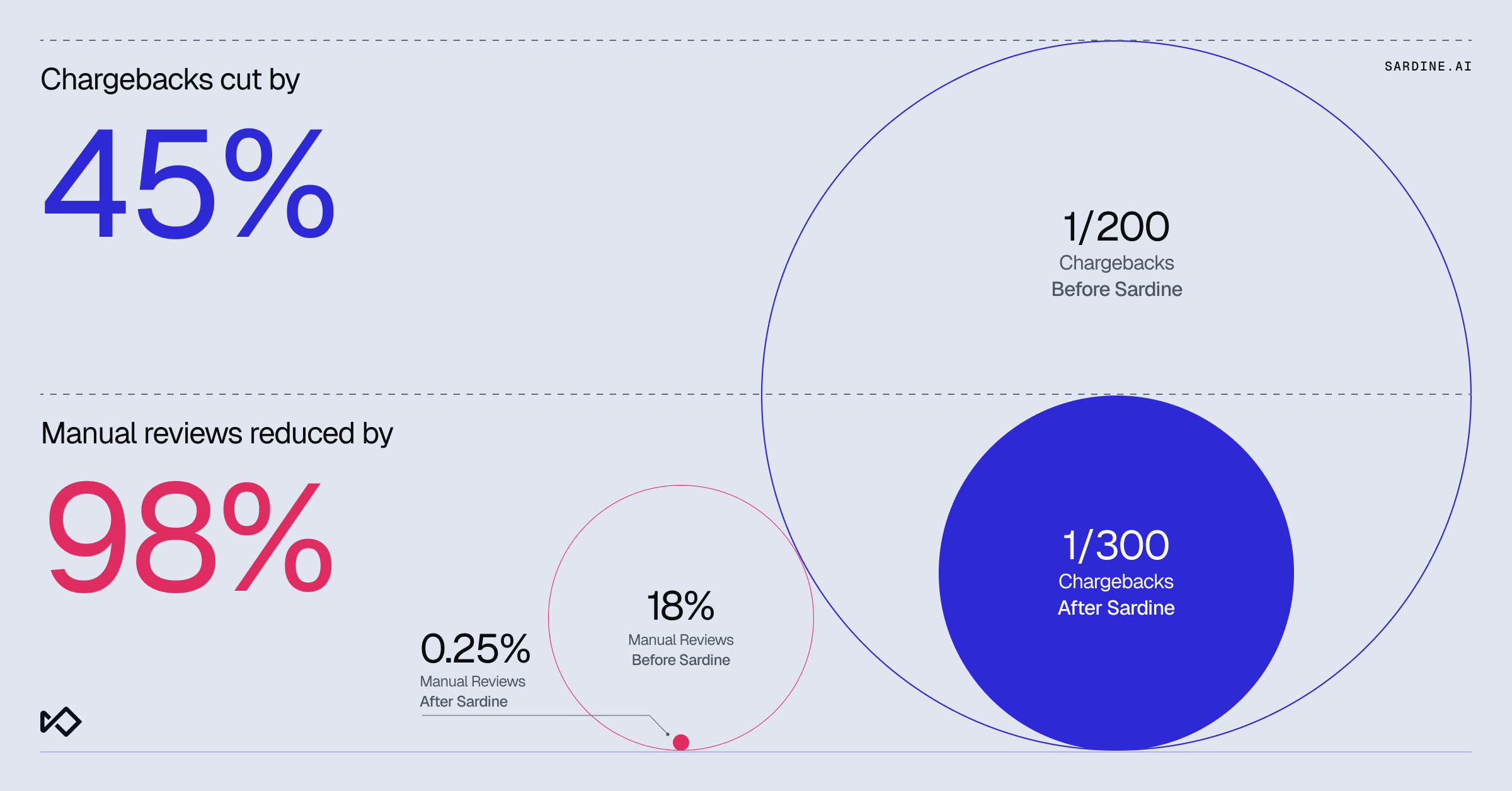
Since partnering with Sardine, Raise has cut chargebacks by 45% and have reduced manual reviews from 18% of transactions to just 0.25%. This means faster service for their 6 million customers and more time for their team to focus on growth as they expand into new markets.
We've loved working with the team at Raise, but to find out more about their experience with us, we talked to Raise's Risk Supervisor, Dartanion Wells.
Why chargebacks were quietly eating Raise’s margin
The gift card industry is a prime target for fraudsters. Its digital nature, high liquidity, and resale potential make gift cards particularly attractive to scammers looking for quick profits.
Raise was facing a specific and growing problem: chargeback fraud. Scammers would purchase gift cards, use them, and then fraudulently dispute the transactions to get their money back, essentially getting the value for free while Raise absorbed the loss.
"Chargebacks were becoming a significant drain on our revenue. At our peak, we were seeing disputes on about 1 in every 200 transactions. It doesn't sound like much, but when you’re processing millions of transactions, those losses add up quickly. And that doesn’t take into account the operational costs of investigating those transactions. " — Dartanion Wells, Risk Supervisor at Raise
Initially, Raise was managing chargeback fraud with a homegrown, in-house system. While this worked in the early days, the more they scaled, the harder it was to keep up:
- Manual reviews had grown to 15-18% of all transactions
- Each review took between 15 minutes and 24 hours to complete
- Over 10,000 hours per year were being spent just on manual reviews
- Customers were waiting longer for their purchases to be approved
"Our customers expect zero friction when buying or selling gift cards. But delivering that smooth experience became harder when our alert queue became unmanageable. We had customers waiting approvals while our team worked through a large backlog of flagged transactions. If someone is buying a gift card, they want it right away. They're not going to wait 24 hours." — Dartanion Wells
Reduced chargebacks, mechanism by mechanism: rules, models, device, behavior
To bring down fraudulent chargebacks, Raised partnered with Sardine to optimize their rulesets for better detection, and train custom ML models to detect specific gift card-related schemes.
"What made Sardine stand out was their willingness to build something tailored to our specific needs. They took the time to understand our existing processes and business requirements, before making recommendations.” — Dartanion Wells
Steadily, the chargeback rate dropped from more than one in every two hundred (0.53%) transactions to less than one in every three hundred transactions (0.29%). It's a win for profitability.

How Raise reduced chargebacks and 98% of manual reviews in the same lift
One of the most impactful benefits of using Sardine has been greater operational efficiency. With the support of Sardine’s AI features, Raise has reduced manual reviews by 98% – from 15-18% of transactions to just 0.25%.
“Surprisingly, automation also helped us cut down false positives because it reduces the human error you get when you’re making judgment calls during an investigation.”
For Dartanion, the software also had another unintended benefit. Training a software program to the highest level once, is a lot easier than training many people, many times.
Reduced chargebacks as a moving target: how Raise and Sardine stay ahead
Raise and Sardine are proud partners, always striving to continue improving results, as well as staying ahead of the scammers. The beauty of Sardine’s technology is that partners can make the service their own, with rules suited to their unique business risks. It's not a one-size-fits-all solution. We dig into where custom rules stop scaling and workflows take over in fraud rules vs. workflows.

We'd like to thank Dartanion and Raise for their continued support and partnership. It's truly been a pleasure to work beside such expert innovators.
Frequently asked questions about reduced chargebacks
What is a chargeback rate, and what is considered acceptable?
Chargeback rate is the percentage of transactions that end in a dispute, calculated as chargebacks divided by total transactions, multiplied by 100. Visa’s monitoring threshold sits at 0.9%, and merchants above 1% face higher fees, reserve requirements, and enrollment in monitoring programs.
How did Raise achieve reduced chargebacks of 45%?
Raise reduced chargebacks by layering Sardine’s fraud detection capabilities on top of its existing rulesets. Sardine used device intelligence, behavioral biometrics, consortium fraud history, and a custom machine learning fraud detection model trained on gift-card-specific abuse patterns. This helped Raise identify chargeback fraud and fraudulent chargebacks earlier, before more risky transactions were approved.
What is friendly fraud, and how does it drive chargebacks?
Friendly fraud, also called first-party fraud, happens when a customer disputes a legitimate purchase after receiving the product or value. In gift card fraud, this can be especially damaging because gift cards are digital, liquid, and easy to use or resell quickly. Strong chargeback prevention depends on identifying suspicious behavior before the transaction becomes a dispute. Mastercard puts this at roughly 75% of total chargeback volume, and Juniper Research forecasts merchant losses to first-party fraud at 100 billion dollars annually by 2026.
How does fraud detection reduce chargebacks without increasing customer friction?
Better fraud detection reduces chargebacks by identifying risky transactions more accurately while allowing legitimate customers to move through the checkout process faster. By using behavioral signals, device intelligence, fraud rules, and machine learning fraud detection, teams can reduce false positives, lower manual review volume, and prevent more fraudulent transactions without slowing down every buyer.
Why did Raise's homegrown system stop working?
Volume. Manual reviews had grown to 15-18% of all transactions, each review took between 15 minutes and 24 hours, and analysts were logging over 10,000 hours per year on the queue. The system worked at startup scale and broke at platform scale.
How fast does Sardine score a transaction?
Sardine provides decisioning and audit context behind transaction approvals and declines, helping fraud teams understand why a transaction was flagged, approved, or sent for review. This gives teams more visibility into fraud rules, model outputs, and the signals used in fraud risk management.
How does Sardine support audit and regulator review?
Every Sardine model decision carries SR 11-7 and NIST AI RMF audit lineage. Sardine provides decisioning and audit context behind transaction approvals and declines, helping fraud teams understand why a transaction was flagged, approved, or sent for review. This gives teams more visibility into fraud rules, model outputs, and the signals in fraud risk management.